Are your products organic?
Actually yes. The land we are cultivating has rested for at least eight years. We use crop rotation for soil improvement and, if necessary, the fertilizers suitable for use in organic agriculture.
Formally not yet. We applied for the certification as the organic farm in 2019. A 2-year transition time to organic farming is awarded after the initial certification. Our farm is inspected by Ekoagros every year. Farm's production of the year 2020 was certified as a transitional to the organic.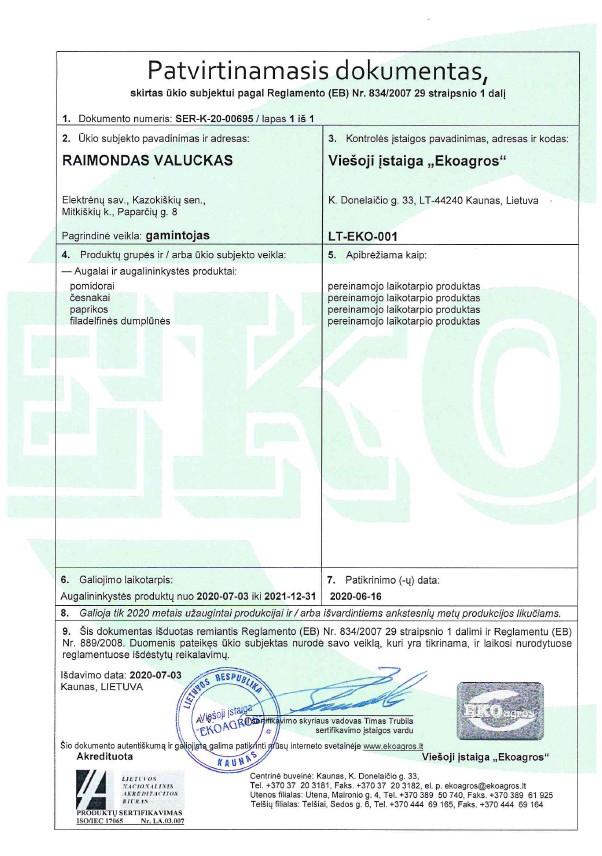
What is difference between organic and conventional farming?
Organic agriculture is a production system that regenerates the health of soils, ecosystems, and people. Organic farmers rely on natural processes, biodiversity, and cycles adapted to local conditions rather than the use of synthetic inputs like chemical fertilizers, pesticides, and herbicides. GMOs are not allowed in organic.
The essential difference between organic and conventional farming is that conventional farming relies on chemical intervention to fight pests and weeds and provide plant nutrition. That means synthetic pesticides, herbicides, and fertilizers. Organic farming relies on natural principles like biodiversity and composting instead to produce healthy, abundant food. Importantly, “Organic production is not simply the avoidance of conventional chemical inputs, nor is it the substitution of natural inputs for synthetic ones. Organic farmers apply techniques first used thousands of years ago, such as crop rotations and the use of composted animal manures and green manure crops, in ways that are economically sustainable in today’s world. In organic production, overall system health is emphasized, and the interaction of management practices is the primary concern. Organic producers implement a wide range of strategies to develop and maintain biological diversity and replenish soil fertility” (USDA, 2007).
Source: https://rodaleinstitute.org/why-organic/organic-basics/organic-vs-conventional/